
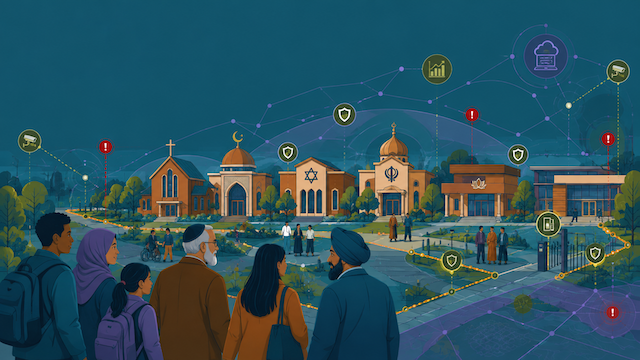
On 07 October 2026, the Faith-Based Information Sharing and Analysis Organization (FB-ISAO) released its 3rd annual analysis and review of Attacks on Houses of Worship. Being an all-faiths and all-hazards information sharing organization, FB-ISAO serves as a trusted partner to inform and equip all-faiths to prevent, protect against, mitigate, respond to, and recover from incidents arising from all-hazards. Specifically, this report provides that all-faiths examination of incidents in which a house of worship was attacked or identified as the target or location of an attack. This all-faiths approach addresses a key gap in existing data sources, which often focus narrowly on hate crimes, a single faith community, or geographic area. This analysis offers a comprehensive examination of the risks confronting houses of worship nationwide.
According to Ed Heyman, co-chair of FB-ISAO’s Operational Resilience Group (ORG) and the project’s principal data collector and analyst, “There is no archetypical attack on houses of worship; they vary by faith, by motivation, and by geographic location. Rather than prepare against a generic threat, security managers should focus on the particular vulnerabilities of their facility. The data contained in these reports can help managers identify which threats they are most likely to face, and how best to defend against them.”
Findings
The threat environment is not simply expanding; it is becoming more violent and combative. Houses of worship across the United States faced 915 reported incidents in 2025, an 8.8% increase from 2024. While the total remained below the 2023 peak, the report identifies a concerning shift: incidents are increasingly physical, violent, and likely to occur outside the house of worship rather than inside the building.
Protestant churches are the most frequent target of attacks. Sixty three percent of all attacks in 2025 occurred at Protestant churches, followed by 14% at Catholic churches, 12% at synagogues, and 5% at mosques. While Protestant congregations were the most frequent target, they make up 85% of all houses of worship in the country and are thus underrepresented in the distribution. Indeed, faiths that represent fewer than 10% of all congregations suffered 31% of attacks.
Six types of incidents – theft, vandalism, assault, arson, graffiti, and communicated threats account for more than 80% of reported incidents. Property crime remained the largest category, but violence increased significantly. Assaults and theft doubled over the three-year period examined, while arson rose approximately 25%.
The number of incidents that resulted in casualties rose substantially from 69 (6.7% of all incidents) in 2024 to 111 (12%) in 2025. In total, 48 people were killed and 154 were wounded, twice the number of casualties recorded the previous year. Most casualties did not result from mass-casualty attacks; they arose from a growing number of individual assaults and other encounters. Assaults accounted for nearly 90% of deaths and more than 86% of injuries.
Firearms and bladed weapons were reported in only 14% of incidents yet produced the 70% of casualties. Vehicles were used in 12% of attacks with casualties. More commonly reported weapons included hands and everyday objects found on-site, including rocks, bricks, and detritus repurposed as blunt weapons.
The interior of a house of worship is generally safer than the exterior when access is effectively controlled. More than half of all incidents occurred outside houses of worship, while fewer than one-third occurred inside. Hardening entrances and controlling access pays off – approximately 89% of casualties and 78% of assaults took place outdoors.
Relative vulnerability changes as you move through the site. The findings reinforce the importance of securing parking lots, walkways, grounds, entrances, vehicle approaches, and adjacent streets. Effective access control appears to reduce risk inside the building, but it must be paired with exterior lighting, surveillance, perimeter awareness, and early identification of suspicious behavior.
The report also notes that common objects found on-site—including rocks, bricks, tools, and landscaping materials—are frequently used in vandalism, forced entry, and assault. Routine maintenance, changes in landscaping materials, and secure storage of tools and other implements that can be weaponized might result in a reduction of incidents and damage to facilities.
Threat Profiles Differ Across Faith Communities. Not only do some faiths get attacked more than others, the kinds of attack they face also varies. Protestant and Catholic facilities experienced more theft, vandalism, assault, and other physical acts. Synagogues and mosques faced more communicated threats, intimidation, graffiti, and disruptive forms activity.
These differences reinforce the need for security measures tailored to each congregation’s faith community, location, property, operating environment, and known local threats.
Cyber Attacks Remain Underreported. Only 10 cyber incidents were identified in the dataset; although the actual number is likely much higher. Phishing, credential compromise, unauthorized remote access, data theft, and extortion can expose donor, financial, personnel, counseling, and children’s ministry information while disrupting giving, payroll, communications, worship services, and ministry operations. Recommended safeguards include multifactor authentication, restricted remote access, protected backups, limited administrative privileges, system monitoring, and rapid reporting of suspicious activity.
Practical Priorities for Houses of Worship
The report recommends a risk-based, data-informed approach that addresses both high-impact scenarios and the threats most likely to occur. Priorities include:
- Conducting a site-specific threat assessment
- Strengthening parking-lot, perimeter, entrance, and vehicle-access security
- Maintaining effective but welcoming access control
- Preparing staff and volunteers to recognize and report escalating behavior
- Improving lighting, surveillance, alarms, and property management
- Securing tools and loose materials that could be weaponized
- Establishing relationships with law enforcement before an emergency
- Strengthening cybersecurity and incident-reporting procedures
- Continually reassessing local, regional, and faith-specific threat information
The central lesson is clear: security planning should be guided by the threats most likely to occur – not only those that garner the most attention or generate the greatest fear. By turning threat awareness into preparedness, mitigation, and resilience, houses of worship can better protect their people, property, information, and mission; and focus on prayer.
These and other findings are examined in greater detail in the full report. Now in its third year, the report includes year-over-year data analysis to deepen our understanding of the threat landscape and support fact-based, data-driven decisions that help protect people and places of faith.
Our efforts to represent all-faiths and to pull in data from more sources will be strengthened by greater participation and collaboration. If you’d like to discuss how you can join FB-ISAO or to collaborate with us, please write to info@faithbased-isao.org.
- Access the 2025 Threat Data Report.
- Access the 2024 Threat Data Report.
- Access the 2023 Threat Data Report.
If you have any questions or need assistance, please contact us.
This is a community of force multipliers working together to
Protect and Secure the Free Practice of Faith