
Traffic Light Protocol (TLP) v2
FB-ISAO uses TLP according to the FIRST Standard Definitions and Usage Guidance.
Introduction
The Traffic Light Protocol (TLP) was created in order to facilitate greater sharing of information. TLP is a set ofdesignations used to ensure that sensitive information is shared with the appropriate audience. It employs four colors to indicate expected sharing boundaries to be applied by the recipient(s). TLP only has four colors; any designations not listed in this standard are not considered valid by FIRST.
TLP provides a simple and intuitive schema for indicating when and how sensitive information can be shared, facilitating more frequent and effective collaboration. TLP is not a “control marking” or classification scheme. TLP was not designedto handle licensing terms, handling and encryption rules, and restrictions on action or instrumentation of information. TLP labels and their definitions are not intended to have any effect on freedom of information or “sunshine” laws in any jurisdiction.
TLP is optimized for ease of adoption, human readability and person-to-person sharing; it may be used in automated sharing exchanges but is not optimized for that use.
TLP is distinct from the Chatham House Rule (when a meeting, or part thereof, is held under the Chatham House Rule,participants are free to use the information received, but neither the identity nor the affiliation of the speaker(s), nor thatof any other participant, may be revealed), but may be used in conjunction if it is deemed appropriate by participants in an information exchange.
The source is responsible for ensuring that recipients of TLP information understand and can follow TLP sharing guidance.
If a recipient needs to share the information more widely than indicated by the original TLP designation, they must obtain explicit permission from the original source.
If no TLP marking is specified, information shall be treated as FB-ISAO Confidential Information (TLP: AMBER).
Definitions
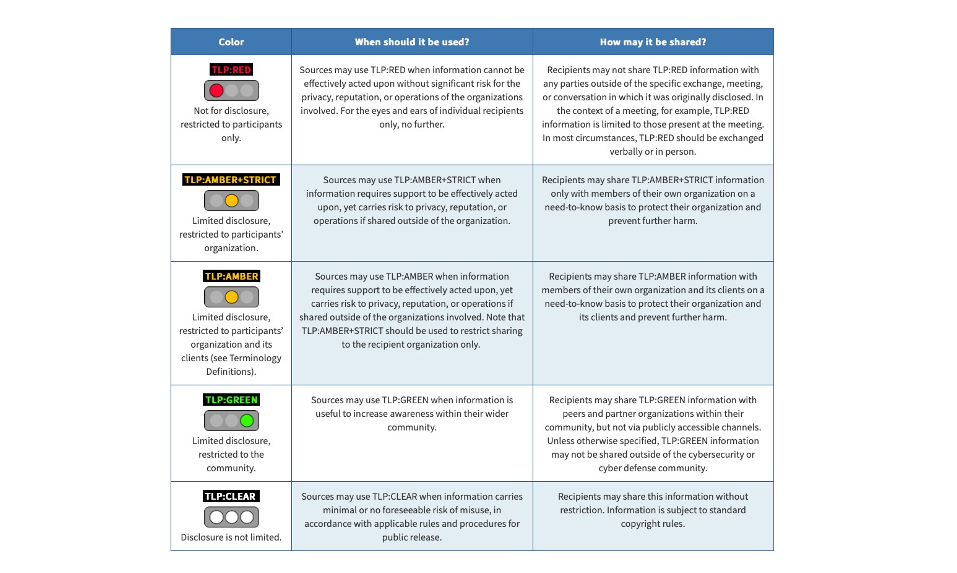
Usage: TLP-designated email correspondence should indicate the TLP color of the information in the Subject line and in the bodyof the email, prior to the designated information itself. The TLP color must be in capital letters: TLP:RED, TLP:AMBER+STRICT, TLP:AMBER, TLP:GREEN, or TLP:CLEAR.
How to use TLP in documents: TLP-designated documents should indicate the TLP color of the information in the header and footer of each page. To avoid confusion with existing control marking schemes, it is advisable to right-justify TLP designations. The TLP color should appear in capital letters and in 12-point type or greater. Note: TLP 2.0 has changed the color coding of TLP:RED to accommodate individuals with low vision.
RGB:
- TLP:RED : R=255, G=43, B=43, background: R=0, G=0, B=0
- TLP:AMBER : R=255, G=192, B=0, background: R=0, G=0, B=0
- TLP:GREEN : R=51, G=255, B=0, background: R=0, G=0, B=0
- TLP:CLEAR : R=255, G=255, B=255, background: R=0, G=0, B=0
CMYK:
- TLP:RED : C=0, M=83, Y=83, K=0, background: C=0, M=0, Y=0, K=100
- TLP:AMBER : C=0, M=25,Y=100, K=0, background: C=0, M=0, Y=0, K=100
- TLP:GREEN : C=79, M=0, Y=100, K=0,background: C=0, M=0, Y=0, K=100
- TLP:CLEAR : C=0, M=0, Y=0, K=0, background: C=0, M=0, Y=0, K=100